
March 2026
Association sets course at Annual Meeting
Illinois Forage and Grassland Council held its Annual Meeting on Jan. 31 at the Sangamon County Farm Bureau Building in Springfield. Members reviewed council business, discussed upcoming initiatives, and voted on several organizational updates.
A large portion of the meeting focused on planning a future forage and livestock educational event, potentially at Spoon River College in Canton. Members discussed structuring the program around educational sessions and producer-focused panel discussions instead of heavy equipment demonstrations to reduce weather risk and focus on practical information for producers.
Potential topics discussed include:
hay production economics
forage quality management
livestock risk management tools
insurance considerations
forage harvesting strategies
regulatory updates impacting livestock producers
The council also discussed membership engagement and improving the tracking and collection of membership dues through online systems to strengthen the organization’s financial stability.
Several administrative updates were approved including bylaw amendments combining the secretary and treasurer positions, authorization of limited field day expenditures, and updates to the council website and payment systems.
The meeting concluded with officer elections and recognition of leadership service to the organization. Doug Gucker was thanked for his years as IFGC treasurer. He remains on the board as a director.
2026 officers are Ron Tombaugh, president; Jon Herron, vice president; and Keely Wilcoxen, secretary-treasurer.
Waste not, want not: Strategies for winter hay feeding
Effective winter hay strategies focus on minimizing waste while protecting hay quality and reducing soil disturbance.
Only feed what they’ll eat daily
“Livestock will waste less hay when the amount fed is limited to what is needed each day,” says Amanda Grev, Maryland Extension. “Daily feeding will force them to eat hay they might otherwise refuse, trample, or waste.”
A 1,300 lb. beef cow needs about 40 pounds of hay a day, eating 32 pounds and wasting about 8 pounds, notes Travis Meteer, University of Illinois Extension beef cattle specialist. A 25-head herd, thus, will go through 1,000 pounds of hay per day, approximately one large round bale a day, though weights do vary per bale.
Spread feeding locations across fields and pastures
To reduce the negative impact to soil of high hoof traffic and to increase the distribution of nutrients, rotate where you place or unroll bales, says Lauren Langley, North Carolina Extension. “Moving feeders around and using temporary fencing keeps livestock from over-compacting any single area.”
Match the bale feeding method to your unique operation
Bale Ring feeders help reduce waste, but may not provide enough space at the feeder for the number of cows and can result in “cows fighting for hay, dominance hierarchy, and more uneven cow performance with young, small cows getting less feed,” Meteer says. It also increases the risk of ground trampling and need for manure removal if rings are not moved frequently.
Unrolling hay bales across a pasture or field helps spread the feeding space, minimizing mud and trampling issues.
“Unrolling hay also allows valuable nutrients from hay waste and animal manure to be deposited back onto the soil and spread across a greater area of the field,” says Grev. “Decomposing hay residue, along with manure and urine, is distributed across the field and can help improve soil organic matter and increase forage growth in subsequent years.”
Illinois Grazing Lands Coalition Executive Director Christian Lovell prefers unrolling hay versus bale rings.
“I have a bunch of baby calves at this time of year,” Lovell says. “By unrolling, they don’t have to compete at the hay ring. Everybody can get a bite.” Lovell also capitalizes on the soil health benefits gained from unrolling versus feeding in a lot or sacrifice area.
“Every time cattle defecate in the lot, that’s nutrients that are not getting on your pasture,” Lovell adds.
But unrolling is not without its disadvantages, including equipment and labor costs and higher hay waste than other methods. Unrolling only what livestock can eat in a day minimizes waste.
Bale grazing involves opening up access to sections of the field where the hay was baled, using virtual or polywire fencing to control which bales are accessible. Producers must balance how much hay and how often they move livestock with the labor cost of moving fencing.
“Similar to unrolling hay, bale grazing can also offer benefits in terms of added soil fertility, improved manure and nutrient distribution, and cleaner wintering conditions for livestock,” Grev says. “Bale grazing is a great way to spread manure and nutrients across a pasture, and bales can be strategically placed on poorer areas of the field, such as those with thinning forage, bare spots, less productive yields, or nutrient deficiencies.”
Frozen wrap on bales may create challenges in icy conditions, Meteer warns, and mud trampling may hurt forage stands and increase weed pressure.
During wet or drought conditions, you may need to feed livestock in a sacrifice area.
Protect your stored hay
Whatever method you use for feeding hay, ensure your hay retains its quality by properly storing hay after harvest. Read Illinois Extension’s Guide for Hay Storage.
Register for April 14 online webinar on forage production
The April 14 session of the Grow & Graze webinar series is focused on forage production. Reserve your seat for the live session.
Grow & Graze webinars are set up as a guided discussion, and we welcome your questions in real time.
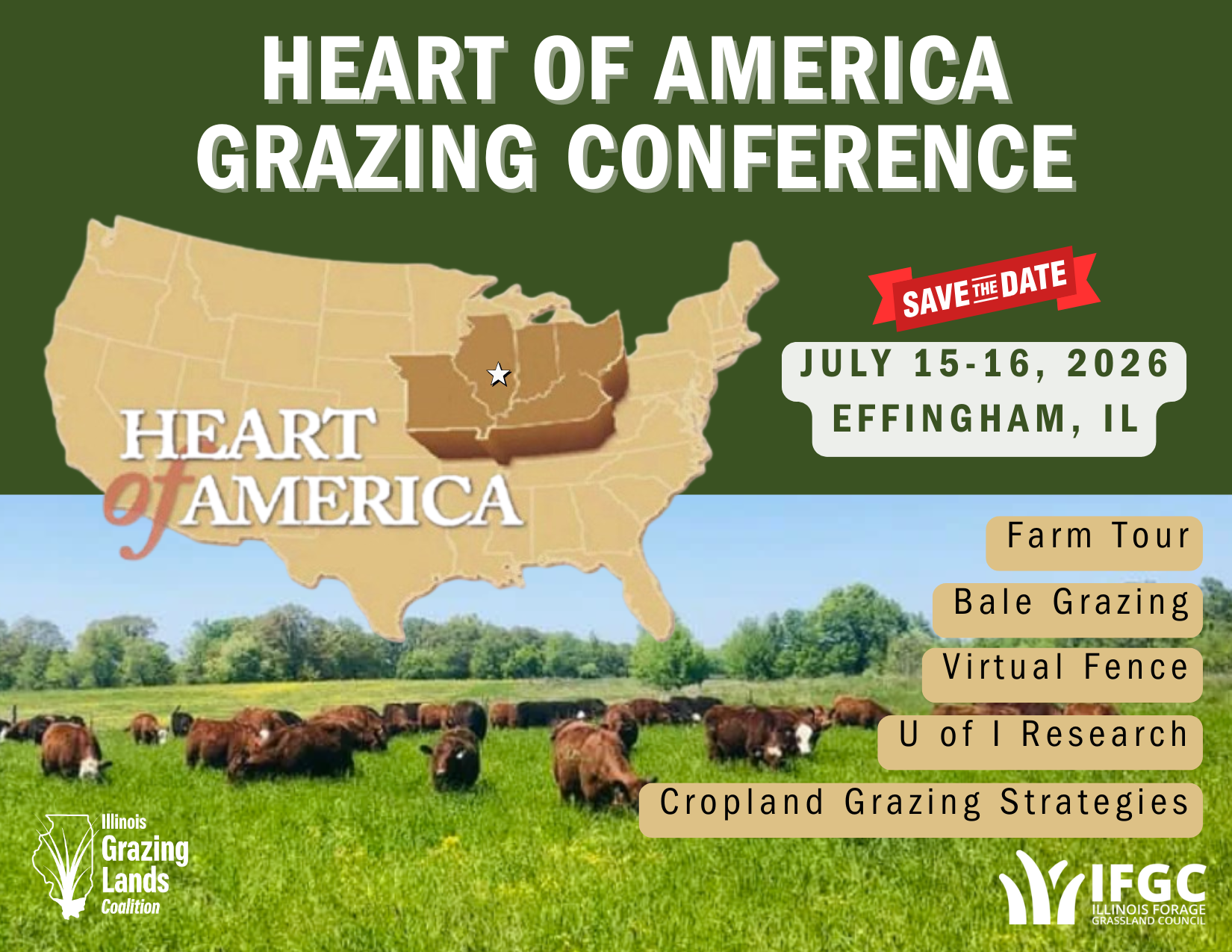
Before the summer calendar fills, save the date for the national Heart of America Grazing Conference July 15 and 16 in Effingham.
The event includes a full day on the Curt Rincker farm to learn about bale grazing, virtual fencing, and cropland grazing strategies.
Participants will also learn how to apply the latest research from University of Illinois.
Heart of America Grazing Conference
Plan now for your 2026 dues
Working together, we can build an agriculture future that supports farm families and soil health.
Member Benefits
All benefits of the American Forage and Grassland Council.
Quarterly Forage Feed newsletter with articles and events of interest.
Corporate members received complimentary standard exhibit space at two IFGC sponsored events per year and recognition in the newsletter and website.
Member Fees
Student Membership: $5
Individual Membership: $30
Northwest IFGC Membership: $50
Corporate Membership: $200
Pay online at the American Forage and Grassland Council.
NATIONAL NEWS
The National Alfalfa & Forage Alliance (NAFA) aims to ensure all segments of the alfalfa and forage industry can compete effectively and profitably. In early February the NAFA board met with congressional and senate offices to advocate for the following priorities.
Securing Federal Research Funding: NAFA efforts have resulted in $4 million annually for the Alfalfa Seed & Alfalfa Forage Systems (ASAFS) research program administered by NIFA, and a re-occurring $5 million boost for alfalfa research in the ARS base budget.
Policy & Agency Initiatives including working with Risk Management Agency on the development of a new Alfalfa Revenue Insurance product; working with NRCS to create a Short-Term Perennial practice in the Conservation Crop Rotation 328 program now offered in all 50 states; working with ERS to have alfalfa included in cost of production data collection to aid in alfalfa’s inclusion in federal economic assistance programs.
Training & Education including the Alfalfa Intensive Training Seminar, and publications like Alfalfa Variety Ratings Winter Survival Fall Dormancy & Pest Resistance Ratings for Alfalfa Varieties (aka Alfalfa Variety Leaflet).
Additional links of interest may be the Alfalfa Checkoff reports page.