
March 2022
With high fertilizer prices, are you better off buying fertilizer or supplemental hay?
Increases in fertilizer prices add to the cost of growing forage for grazing. This leads farmers to ask if they should buy hay or fertilizer, says University of Missouri (MU) Extension nutrient management specialist John Lory.
Comparing the benefits of buying hay versus applying fertilizer for better yields is complicated, but it is crucial to the bottom line, says Lory. A fair comparison looks at the costs of hay versus fertilizer, whether the farmer can use the grown forage or purchased hay and the nutrient efficiency of the grown forage versus purchased feed.
Studies at the MU Forage Systems Research Center in Linneus and MU Southwest Research Center in Mount Vernon give some insight, he says. MU researchers found that 50 pounds per acre of nitrogen boosted spring pasture yield by an average of 1,100 lbs. per acre. With nitrogen fertilizer prices near $1/lb., the cost of that feed is 5 cents/lb.
Outlook for the 2022 hay market
Hay prices were unforgiving to livestock producers last year, and will likely continue to be so through 2022.
What is the cost based on utilization rate? Lory explains that cattle only eat part of the forage available to them, leaving the rest to waste. High prices make it critical to manage pastures for high forage utilization rates. Research shows that cattle eat about 60 percent of available forage in highly efficient spring grazing systems, but rates typically dip below 50 percent. That means that cows waste about half of the fertilized forage. At 50 percent use, the actual cost of consumed forage doubles, says Lory. If nitrogen fertilizer is $1/lb., cost of consumed feed is 10 cents/lb. Many farmers can buy hay for less than that now.
Forage use for purchased feed usually runs higher than that for grazing, says Lory. Hay utilization rates can reach 80 percent but most often are closer to 65 percent. If hay is $80 per ton, the cost per pound is 4 cents. However, at 65 percent utilization, the cost per pound of feed eaten goes to 6 cents. “These examples show how purchased feed has the potential to be an economically competitive approach compared to buying fertilizer when prices are high,” says Lory.
Improving hay-feeding efficiency on your operation
Over the last 50 years, hay production has steadily increased, while the beef cow inventory has remained relatively constant.
The fertilizer value of hay can offset cost.
“When you bring hay or other supplemental feed onto your farm, you are buying feed and fertilizer at the same time,” says Lory. “A ton of fescue hay contains nearly 100 lbs. of fertilizer nutrients. If spread strategically on your farm, these nutrients provide fertilizer value to offset the cost of the hay.”
Beef cows typically excrete most of the nutrients they eat. To get the most value from hay, move the hay and cows to pastures that need fertilizer. Unroll hay bales, move hay rings or use some type of bale-graze system to spread across pastures. All of the excreted phosphate, potassium, sulfur and micronutrients in the hay are available to the pasture as fertilizer, but only about 25% of the nitrogen is available. The rest is lost or tied up in the soil organic matter. So, a ton of hay with 12.5% protein provides about 10 lbs. of nitrogen fertilizer, 12 lbs. of phosphate and 35 lbs. of potash.
The fertilizer value of hay is usually a little over a penny per pound, or slightly more than $20 per ton. Recently, nitrogen prices rose to nearly $1/lb., and phosphate and potash prices more than doubled. This increases the fertilizer value of hay to more than 2.5 cents/lb.
Evaluate vitamin A supplementation for beef cattle
Drought brings many nutritional and animal health related challenges. Cow performance issues during the grazing season may result from reduced forage quality and quantity.
In pastures, nutrients brought onto the farms as feed or fertilizer recycle and improve yields. When winter feeding hay, the hay’s fertilizer will increase spring pasture growth. When properly managed, about 5 tons of feed on a pasture with a total nitrogen fertilizer value of 50 lbs. can provide an additional 1,000 lbs. or more of quality spring forage growth.
Fertilizer value also can influence hay purchase decisions, says Lory. Buying high-quality hay increases the fertilizer value of the hay. With current costs, a ton of hay may have $20 more fertilizer value than poor-quality hay, making the higher-quality hay the more economical feed, even if it costs more up front.
Overwintered cattle may spread weed seeds
Producers who have relocated their cattle out of state for winter feeding this year should consider having a weed management protocol in place when the cattle return, say North Dakota State University (NDSU) Extension specialists.
“Buying hay instead of fertilizer can provide a predictable feed supply to supplement spring pasture growth at a known price,” says Lory. “High utilization can be assured through judicious feeding practices, and unneeded hay can be stored if not used. With high prices, the fertilizer value of the hay has more than doubled, currently around 2.5 cents per pound of forage or $50 per ton, offsetting a significant fraction of the cost of hay. The fertilizer value of the hay also will boost spring forage growth.”
No matter how you meet your herd forage needs, he adds, high prices require you to maximize forage utilization, both when feeding hay and managing pastures.
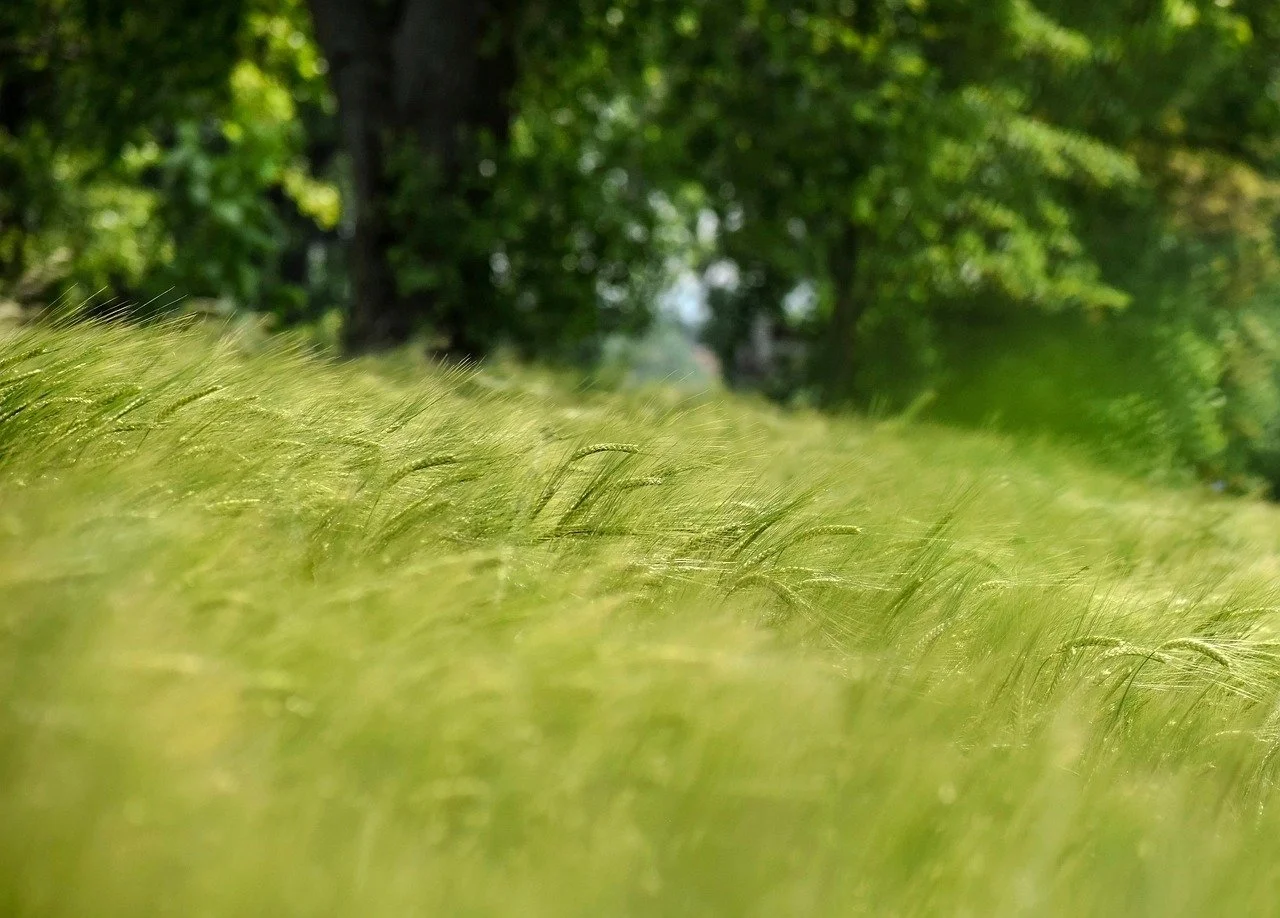
Small Grains Have Large Value For Livestock Producers
Small grains are becoming increasingly popular crops for North American farmers. For many, they serve as cover crops to help prevent soil erosion and nutrient loss in addition to sequestering carbon in the soil on cropland that would normally be bare during the fall and winter months. They can also be useful in crop rotations to help manage weeds or disease cycles (especially for certified organic operations).
For livestock producers, however, small grains such as oats, barley, wheat, rye and triticale (a cross between wheat and rye) can be a versatile, valuable forage crop. They are often part of a planned rotation, planted in the fall after corn silage season and harvested as silage in the spring (except for oats which generally do not survive freezing winter temperatures). Oats and other spring grains can provide a quick emergency forage crop when planted early in the spring to replace alfalfa stands lost to winterkill. They can also be planted in late summer for pasture in order to extend the grazing season into the fall and winter. Be sure to test the crop for nitrates before grazing in the fall if you have experienced a drought or sudden frost because harmful nitrates can accumulate when plants are stressed.
Harvest timing is critical when trying to produce top quality forage. To achieve the highest digestibility the crop should be harvested after the flag leaf appears but before the head emerges (boot stage). Once the seed head emerges the stem elongates, dry matter yield increases but the fiber level also increases and fiber digestibility decreases. If the small grain is planted as a “nurse crop” along with perennial species like alfalfa or clover, harvest timing should be dictated by the growth stage of the permanent crop. You should harvest after the new seeding is well established but before the grain crop has a chance to out-compete the seedlings for sunlight and nutrients.
Choosing the best small grain for your operation can be a challenge. The first consideration should be to select the grain species that performs best under your local conditions. Your agronomist should be able to help with this decision along with information from local and regional universities. A number of universities plant yield trials for small grain forages which can help you get information on relative yields among the various crops and varieties planted.
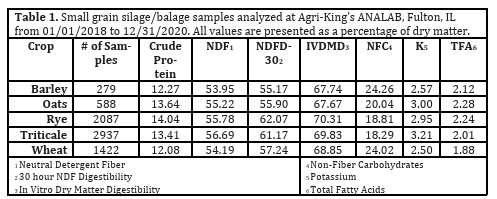
What about forage quality? A number of factors such as fertility level, weather, and harvest timing can affect the forage quality of small grain silage. What differences are there between the different species of grains? Agri-King’s lab tests tens of thousands of forage samples each year from all across North America and the UK and Ireland. Following are the results from small grain silage and balage samples analyzed at Agri-King’s ANALAB in Fulton, IL from 2018 through 2020.
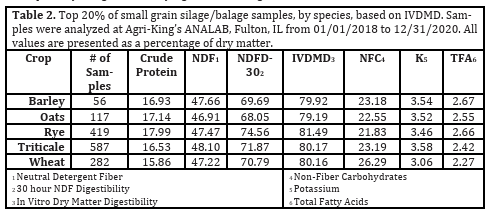
These are all of the samples that were identified by the submitter as being small grain silage or balage. With this many samples there was quite a wide range of maturity and forage quality. Table 2 shows the results for the average of the top 20% of samples from each crop as ranked by In Vitro Dry Matter Digestibility (IVDMD). These would be good targets to shoot for if you are planning on managing your crop for maximum forage quality. As you can see these top samples are definitely high enough quality to feed to high-producing dairy cows. You don’t have to relegate your small grain silages to just the heifers and dry cows. One thing to note is the potassium (K) level of these samples. Many producers plan on feeding these small grain silages to dry cows, but due to the relatively high K levels present these may not be the best choice as the primary forage in diets trying to achieve negative DCAD ratios.
As you can see, small grains can be a source of high-quality forage in addition to being an important part of your cropping rotation. With proper management your small grains can lead to big profits for your operation!
By Dr. Gene P. Gengelbach, Ph.D., P.A.S. Reprinted with permission from Agri-King Advantage
IFGC Annual Meeting
The IFGC Annual meeting is planned for March 12 at the IL State University Farm Conference Center located at 25578 ISU Farm Lane, Lexington, IL 61753. Directors and officers will be elected.
Paid members are allowed to serve as officers or directors. Membership dues can be paid online.
NW IFGC Winter Tour
The NW IFGC winter tour was February 16, 2022. The tour group included 36 members and guests. They toured the Crave Brothers Dairy and Cheese Factory in Waterloo, WI. The farm has a 60 cow rotary milking parlor. The afternoon tour included Renk Seed in Sun Prairie, WI. Cheeseman Coaches provided transportation
2022 Spring EVENTS
March 12—: Forages for Feed, IFGC Winter Program, Lexington, IL
June 8: IL Forage Expo, held in conjunction with the IL Beef Association Summer Meeting